admin
admin 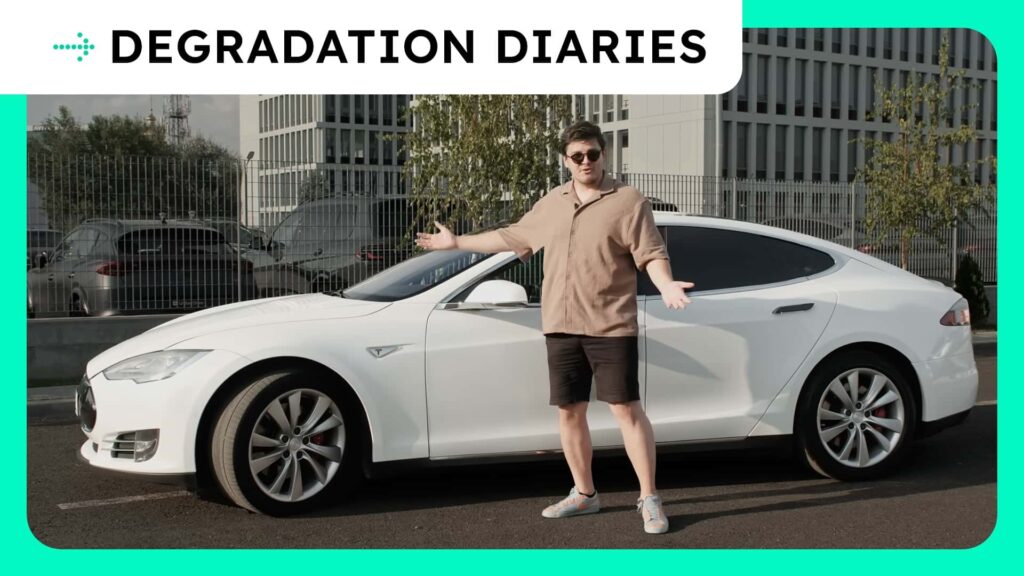
Early Tesla Model S sedans have reached the most interesting stage of their lives. These cars, which were once worth six figures, can now be found for less than the price of a new Honda Civic. They still offer generous passenger and luggage space, effortless performance, and enough real-world range to work as everyday family cars.
But most people want to know one answer before snapping one up: How has the battery held up? Most used car buyers likely assume that an old EV like an early Model S must have lost most of its range by now, and they don’t want to have to deal with replacing the pack. There’s good news, though: They probably won’t have to.
Welcome to Degradation Diaries, my column that breaks down everything you need to know about how EVs age.
Photo by: Andrei Nedelea
The fear is understandable. A replacement high-voltage pack could easily turn a cheap used Tesla into a ruinously expensive one, and most early cars are now beyond their original battery warranties. But the evidence from surviving high-mileage Model S’s suggests that the battery may not be the component buyers should fear most.
While the Nissan Leaf has probably made everybody fear battery degradation more than they should, the Model S does the exact opposite. Even examples that are over 10 years old and have covered around 200,000 miles still typically retain between 85% and 90% of their original capacity, depending on the kind of life they lived.
That still translates to a real-world range of around 200 miles (320 km), which is pretty acceptable even by current standards. That’s still enough to make it a thoroughly usable daily driver.
This One Has Covered 160,000 Miles, And It’s Fine

Photo by: Andrei Nedelea
I recently drove a 2015 Model S P85D that had covered almost 160,000 miles (roughly 260,000 kilometers) on its original battery. Since it had older MC1 hardware, it couldn’t perform an overnight battery health test, which paints an accurate picture of the battery pack’s health. However, you can connect it to the Tessie app, which estimated that the pack retained around 86% of its original capacity.
The figure is purely an estimate, but it aligns with actual health tests on similar- or even higher-mileage cars, and it’s certainly an impressive result for a battery that is more than a decade old. The car can still cover around 186 miles (300 km) at highway speeds, or more under easier conditions.
That is a long way behind the latest Model S or most modern midsize electric sedans, but it remains enough for daily use and occasional road trips. And it represents a pretty reasonable level of degradation for such an old EV, as the car came from the factory with up to 305 miles (491 km) of NEDC range and a more conservative 253-mile (407 km) EPA rating.
The performance is also still there. With 691 horsepower, the car I tried could really pin you to your seat, and the acceleration didn’t seem to relent even as you approached and exceeded typical highway speeds. Few cars can keep up with an early Model S Performance, especially off the line.
Battery Health Isn’t Guaranteed, So Test It
Photo by: Andrei Nedelea
Even if most old Model S batteries seem to have aged quite well, you should still have its battery tested before you buy a used one.
Battery condition can vary depending on a multitude of factors, and two seemingly identical cars built at the same time could have aged very differently because they were used differently. Buyers should never assume that a car is healthy solely because it still shows an acceptable estimated range (although that is a good sign).
But you should never buy based solely on the odometer and the displayed range estimate.
Ask whether the battery or either drive unit has previously been replaced and request invoices wherever possible. These are both big and expensive jobs, so if they were done, the owner likely kept all of the paperwork.
A lengthy test drive is also essential. Arrive with a reasonably high state of charge, monitor consumption and predicted range, and ideally include a Supercharger stop. An old Model S that drives normally but charges abnormally slowly could still be hiding an expensive battery issue.
The owner of the P85D I drove generally limits daily charging to 80%. When he charges to 100%, he begins driving soon afterward rather than leaving the battery full for hours. He also avoids parking the car overnight at an extremely low state of charge. Those habits may have helped maintain the pack’s condition over the two years he’s owned it.
The All-Important SC01 Option
Photo by: Andrei Nedelea
What made the car I tried special was that it had the “SC01” free lifetime Supercharging option, which is transferable to new owners. This means the car saw a lot of DC fast charging throughout its life, and it didn’t destroy the battery over more than a decade of use.
That means a qualifying Model S can continue charging at Tesla Supercharger stations without paying, even after the car changes hands. For someone who drives substantial distances, that can fundamentally alter the ownership calculation.
Its current owner continues to mostly Supercharge the vehicle and regularly takes it on a 250-mile (400 km) cross-country route, which the car never has any issues with. It has saved him thousands in fuel, and the allure of free charging is very hard to ignore.
It can make an old Model S especially appealing to apartment dwellers without private charging or frequent highway travelers. It also makes the car easier to justify despite its relatively high consumption, which is around 20% higher than that of a 2024-2025 Model S (if we compare their official MPGe ratings) and considerably higher than that of a smaller, lighter, and more efficient Model 3.
Its relatively inefficient drivetrain becomes less important when you’re not paying for the energy. There are some limitations, though the biggest is that it only applies to Tesla Supercharger sites.
Tesla’s fair-use policy restricts certain commercial uses, including taxi and rideshare operation, unless charging is paid for. When looking to buy one, you should not rely on the words “free Supercharging” in the ad. Some Tesla charging benefits, like the SC05 option, were tied to the original owner and disappear when ownership changes.
Tesla says the free-charging status can be viewed under “Specs and Warranty” in the app, but a potential buyer can only see it after being added as a driver by the registered owner. It’s very important to have the seller provide the relevant vehicle information and obtain the strongest possible confirmation that the car carries the transferable SC01 benefit before parting with your money.
You can find the SC01 option on vehicles built from the start of Model S production in 2012 through January 2017, but your safest cutoff year should be 2016. The chance of finding one built in 2017 that has this option seems slim, so set your cutoff date at 2016 in your used Model S search just to be safe.
The Rest Of The Car May Be The Bigger Risk
Photo by: Andrei Nedelea
Pre-2017 Model S sedans have now fallen well into budget-EV territory. Kelley Blue Book currently values most 2015 models at roughly $11,500 to $16,850 from dealers, with private seller values starting at just over $10,000. They originally cost between $70,000 and $110,000, and in Europe they were even more expensive.
Mileage, battery condition, and specifications can move those figures considerably, but usable 60-, 70-, and 85-kWh cars can now cost less than many much smaller used EVs, while early P85D and P90D models offer former six-figure performance-car pace for well under $20,000.
The one I tried was originally purchased in 2015 in Germany for over €130,000, but the current owner picked it up for just €21,000 two years ago. In Europe, the cheapest Model S I found with the free Supercharging option was €14,000 (around $16,000), with a seller-claimed 88% battery health rating. You can probably find them even cheaper.
The irony is that on a decently maintained early Model S, the battery may be the least of your worries. These are aging luxury cars packed with power and numerous electronic components. Door handles, screens, panoramic roofs, climate systems, charging port mechanisms, and air-suspension components are all known to fail and can still result in large bills.
The P85D I sampled had a temperamental powered tailgate and a small leak in its air suspension, which caused the front of the car to sag slightly after being parked for more than two days. The suspension still functioned normally while driving, but leaks can eventually make the compressor work harder and contribute to further failures.
Early MCU1 infotainment computers can also feel slow and have known storage-related weaknesses. Tesla offers an MCU2 upgrade for some older cars, but the retrofit adds another significant potential expense (though it shaves years off the car’s feel). If you’re lucky, the previous owner may have already done it.
A cheap Model S is still a complicated flagship vehicle. And while you may get lucky and find one with the SC01 option, its maintenance costs will be similar to those of any luxury car from the era, and even small jobs can end up costing a lot.
It’s Still A Lot Of Car, But Buy Carefully
23
Source: Andrei Nedelea
Assuming the battery and major systems check out, an early Model S still offers an unusual amount of car for the money. It is spacious, practical, and comfortable on long trips, with a large hatchback opening, a useful front trunk, and rear-seat space that remains competitive with many newer EVs.
Its performance hasn’t aged one bit. Even non-Performance early cars are still quick by modern standards, while versions like the P85D remain faster than almost anything available for similar money. The design has held up, too, and a well-kept example does not immediately look like a decade-old EV, and if you think it does, you can retrofit the later facelift front end, which will shave years off.
There are objectively better electric cars today, but nothing comes close for the money. Just have the battery checked, test every powered feature, set aside money for unplanned repairs, and double-check that any SC01 free Supercharging benefit will transfer with the car. Find the right example, and it can still be one of the most compelling used EVs on the market.